
Crypto escrow for real estate
RealOpen fits seamlessly between the blockchain and the existing real estate infrastructure. You fund by sending a crypto transfer; sellers, agents, and escrow companies see U.S. dollars. On an all-cash purchase the wire funds the purchase price. On a financed purchase it funds your approved down payment and applicable closing costs while your lender supplies the mortgage proceeds. No crypto clauses, no contract mods, no seller headaches.
Escrow never touches crypto. It receives a standard domestic wire.
What is crypto real estate funding?
Crypto real estate funding is the process of converting cryptocurrency such as Bitcoin, Ethereum, or stablecoins into the fiat currency required to fund a traditional real estate closing. The buyer funds using cryptocurrency, RealOpen executes the crypto-to-fiat conversion through an OTC trade, and escrow is funded by domestic wire transfer so the seller receives fiat.
If you are new to this category, see our full guide to buying real estate with crypto. To see escrow and title settlement in detail, read the crypto real estate escrow guide. To see the step-by-step RealOpen workflow, go to how RealOpen works and crypto proof of funds and the accepted crypto assets. If you are focused on dollar-pegged assets, see how stablecoin-funded purchases work.
The RealOpen closing flow
Crypto to fiat en route to escrow
Crypto Funding Flow
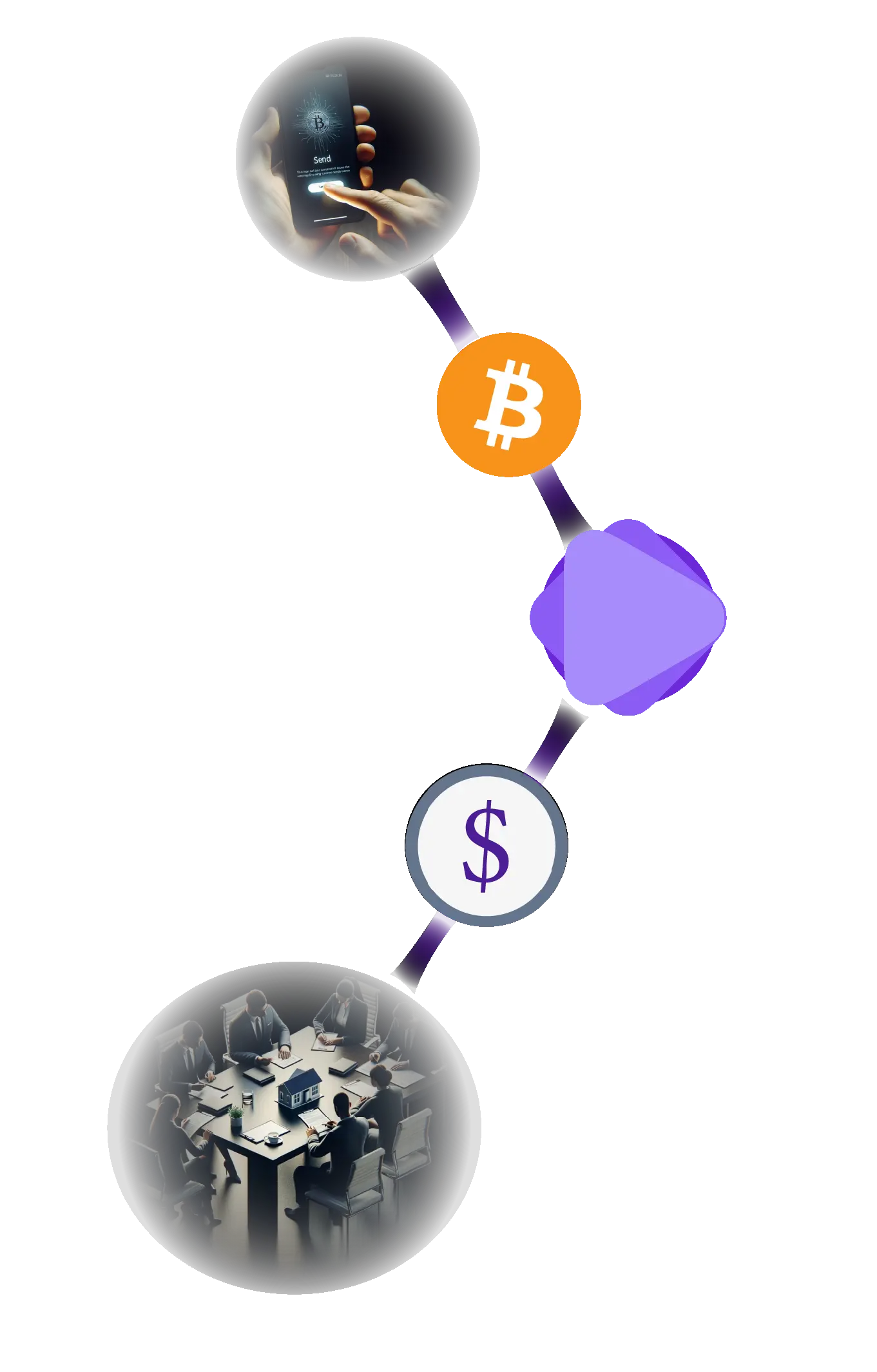
A typical crypto-funded real estate purchase follows this sequence.
PHASE 1: VERIFY ASSETS
Verify Holdings
Generate Proof of Funds
PHASE 2: OFFER
Submit Offer
PHASE 3: FUND THE TRANSACTION
Send Crypto
Convert to Fiat
Wire to Escrow
PHASE 4: CLOSE
Close Transaction
Once your purchase offer is accepted and it's time to fund the purchase:
- You send us the purchase contract + escrow wiring instructions
- We provide you with a crypto deposit address + required crypto amount
- You send crypto (BTC, ETH, USDT, etc.)
- We convert to fiat via prime OTC trade
- We wire to escrow on your behalf
- Escrow closes on your contract — all-cash, or financed with your lender funding the loan
No ambiguity, no exchange withdrawal limits, and no bank headaches. The process is simple and secure. Funding a purchase from a seven-figure sale? Read how large crypto transactions are executed and settled for the exchange limits, OTC pricing and bank-availability rules that run before escrow’s deadline does.
You're in control
No fighting with a crypto exchange about withdrawal limits
You decide how and when to fund:
- Send all funds in one transfer, or break it into chunks
- Fund on closing day or earlier during escrow to catch favorable trading days — on a financed purchase, on the funding date your lender and escrow approve
- Earnest money is separate: on an all-cash deal send it through RealOpen or from your bank; on a financed deal confirm the permitted source and route with your lender and closing agent first and use lender-approved funds
Send your crypto from any wallet type: hosted, self-custody, multisig, cold storage.

Before you send: confirm the instructions
A crypto transfer is final. Seven checks, none of which adds a step to the funding flow:
- Take the deposit instructions from your signed-in RealOpen dashboard. That is the only place a deposit address appears; RealOpen never sends one, or changes one, by email, text, direct message or phone.
- Confirm the asset and the blockchain network match what you are about to send. A token sent on the wrong network can be unrecoverable.
- Check the complete receiving address, not just the first and last characters, and confirm that the address your wallet shows before you sign is the one on the dashboard.
- Include any required memo, destination tag or reference exactly as shown. Chains that use one, such as XRP, credit the transfer by it.
- Treat any unexpected change to deposit or wire instructions as suspicious, however plausible the explanation.
- Confirm a change only through a RealOpen channel you have already verified: the signed-in dashboard, or a call you place to a number you already have, never a number or link in the message that announced the change.
- Never take transaction instructions from an unsolicited email, a direct message or a search-result advertisement.
RealOpen never asks you to connect a wallet app, grant wallet permissions, or share a private key or recovery phrase; wallet ownership is proven with a signed message or a small verification transfer. Each payment is quoted and matched on its own, so a verification transfer or an earlier payment is not a guarantee that a later transfer will be accepted: check every send against its own instructions. The same discipline applies to the escrow wire, which is why RealOpen verifies escrow’s wire instructions by phone before any dollars move.
What escrow sees
A dollar wire with reference details.
Escrow receives a standard incoming domestic wire with reference details and never touches crypto. On an all-cash file that wire is the purchase funds. On a financed file it is your down payment and closing costs, and escrow still follows the lender's closing instructions for the loan proceeds. Upon request, we're happy to provide escrow with a Third-party Funding letter that confirms we are sending your money per your direction.

What the seller sees
A typical sale, funded in dollars.
RealOpen was created to eliminate friction. The seller sees:
- A verified buyer — crypto-backed Proof of Funds on a cash offer, lender preapproval on a financed one
- A standard contract that states the actual financing (no crypto language required)
- Escrow funded in dollars
If the listing side asks for documentation, share a formal proof of funds letter rather than wallet screenshots.
No friction.

Speed, security, and convenience
Take the crypto off-ramp express lane.
We work exclusively with top-tier OTC desks and compliance partners:
- Realtime compliance checks
- Institutional-grade prime pricing
- Support for large transaction amounts
- Conversion + wire typically processed in a half day
We make closing with crypto simple, fast, and painless — for everyone involved.
Related reading: for the broader transaction sequence, read how crypto real estate transactions work, and for buyer verification before funding, review crypto proof of funds. Holding staked assets? Supported staking positions count toward your verified balance and are disclosed as staked; here's how staked crypto works for proof of funds and closing.

Whether you're holding BTC, ETH, or stablecoins — RealOpen turns your crypto into real estate without the friction. Create your account, verify your identity, and become a verified buyer in minutes — ready for a cash offer or a crypto-funded down payment.
Related help
About buying real estate with crypto
by Johnny Schiro
4 min read

Your Bitcoin Is Now Their IOU
The branded crypto mortgage disclosed the part the launch coverage skipped: pledged bitcoin can be rehypothecated, stays locked until the entire conforming loan is repaid, and can be sold after 60 days late. The rule underneath still asks none of that.
by Johnny Schiro
4 min read

The 250% Fine Print on Crypto Mortgages
Every crypto mortgage headline is about one branded product: two loans, a second lien, 250% of your down payment pledged in bitcoin. The rule underneath is free and works with your own lender under its program’s rules — no pledge, no second lien. Know the difference.
by Johnny Schiro
4 min read

Don't Tokenize the House. Tokenize the Buyer.
A decade of trying to put houses onchain produced a rounding error. Robinhood Chain suggests the real shift is the other side of the transaction: the buyer's balance sheet. What happens to real estate when wealth itself becomes onchain and verifiable?
by Johnny Schiro
2 min read

Tokenized Real Estate Is Still 0.1% of Everything
A decade of trillion-dollar projections, a market share you need a microscope to find — and what crypto buyers should do instead.