Reading Time
3 min
The 250% Fine Print on Crypto Mortgages

Johnny Schiro
RealOpen SVP, Business Development
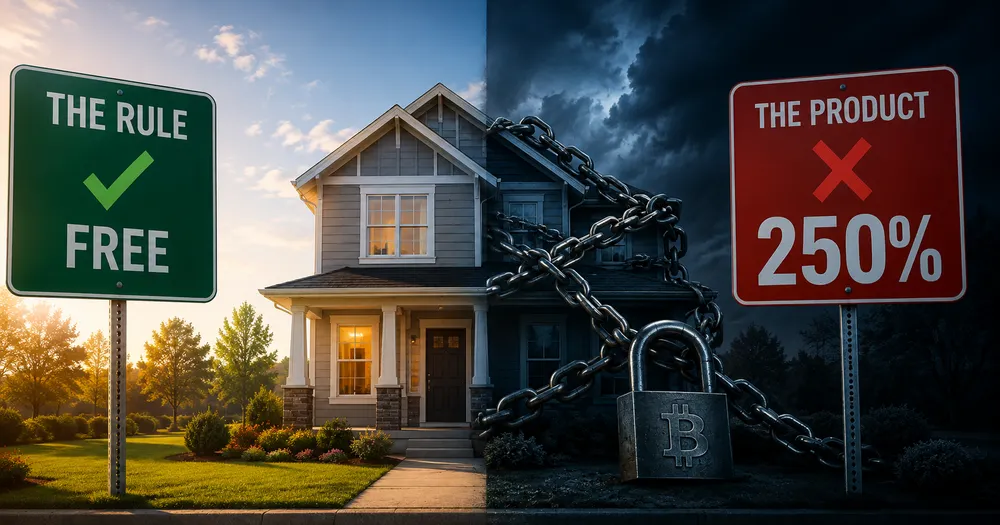
Crypto-backed mortgages are having a moment. The first Fannie-conforming token-backed loan closed in June, the waitlist reportedly represents about $250 million in volume, and the biggest banks in the country are said to be lined up to buy the loans.
Before you join that waitlist, separate two things the coverage keeps blending into one.
The rule and the product are not the same thing
The rule is the actual news, and it's free. In 2025, the FHFA directed Fannie Mae and Freddie Mac to develop rules for counting crypto held on regulated exchanges toward mortgage reserves — without converting it to dollars first. That's a change to conventional loan qualification itself. No partnership, no pledge, no second lien, no branded program. Implementation is still rolling out and lender adoption varies, but the direction is set: your crypto can strengthen a plain conforming mortgage application at any lender who's caught up, the same way a brokerage account does.
The product is a private two-loan structure from a lender/exchange partnership that launched into the moment the rule created. Products have marketing budgets; rules don't — which is why every headline you've read is about the product, and why it's easy to come away believing the branded program is the only way crypto touches a mortgage. It isn't. It's a markup on the rule.
So evaluate the markup on its own terms.
What the product actually asks of you
The structure is two loans. The first is a normal conforming mortgage secured by the house. The second is a privately financed loan secured by your crypto — and by a second lien on the same house.
To fund a down payment this way, you pledge collateral worth 250% of the down payment in bitcoin, or 125% in USDC. You pay interest on both notes. Your coins sit locked for the life of the arrangement.
Read that 250% number the way an underwriter wrote it, because it's the most honest sentence in the whole product. A lender who believed bitcoin was pristine collateral would ask for 110%. Asking for 250% is the lender telling you, in underwriting language, exactly how far they think your bitcoin can fall while they're holding it. You don't have to agree with them. You do have to post the margin.
To be fair, the product isn't maximally cruel: there are no margin calls if prices fall, and liquidation only triggers after 60 days of payment delinquency. But that's a description of when they sell your bitcoin, not whether they can.
The September disclosure added the part about what happens to the coins in the meantime: Your Bitcoin is now Their IOU.
The buyers aren't broke. That's the tell.
Reportedly 41% of waitlisted applicants "lack sufficient cash" for a traditional down payment. Look at who signs up and you don't find people who can't afford houses — you find people whose net worth is denominated in an asset their lender demands 2.5x margin on. They have the money. The product exists to let them keep pretending they haven't spent it.
That's the pitch, stripped of the innovation language: pay two interest rates so you don't have to admit you sold. It's a financial product engineered around a feeling — built on top of a rule that never asked this much of you.
What the rule alone gets you
If you want a mortgage — leverage at 6.7% on an appreciating house can be a rational trade — the unbranded path is already there. Crypto on a regulated exchange counts toward reserves in qualification as adoption spreads. A documented, properly sourced conversion funds the down payment. That's one house, one loan, zero pledged coins, any conforming lender — the whole playbook is at crypto down payments.
One fine-print item in the rule itself deserves a flag: "held on a regulated exchange." That's the qualification system asking you to hand over your keys to prove you have hands. If you self-custody — and if your position is big enough to buy a house, you probably should — you don't have to park coins on an exchange just to make them legible to a lender. A RealScore™ Report verifies wallet ownership and holdings cryptographically, states a volatility-adjusted conversion value, and stays verifiable by document ID — a lender-ready account of what you actually hold, from cold storage, with your keys exactly where they belong.
And if your crypto can cover the house outright, skip the mortgage entirely: sell at closing, wire escrow, close as a cash buyer, take the deed. No lien on your coins, no second note, no 60-day countdown attached to your net worth. That's what RealOpen does, and it's why we exist.
There's a fight in Washington over whether the branded product should exist at all. You don't need to wait for the outcome, because the math is already public: the rule is free, and the product charges you twice to avoid using it plainly. You were never the customer. You were the collateral.
Sell the coins or source the coins. Either way, own the deed.
Last updated

RealOpen lets you buy any house with crypto.
On the market, pocket listed, or just a home you love—RealOpen's platform, handles KYC, proof of funds, and volatility modeling to present an all-cash offer to sellers while you get to hold crypto until closing.