Reading Time
2 min
Tokenized Real Estate Is Still 0.1% of Everything

Johnny Schiro
RealOpen SVP, Business Development
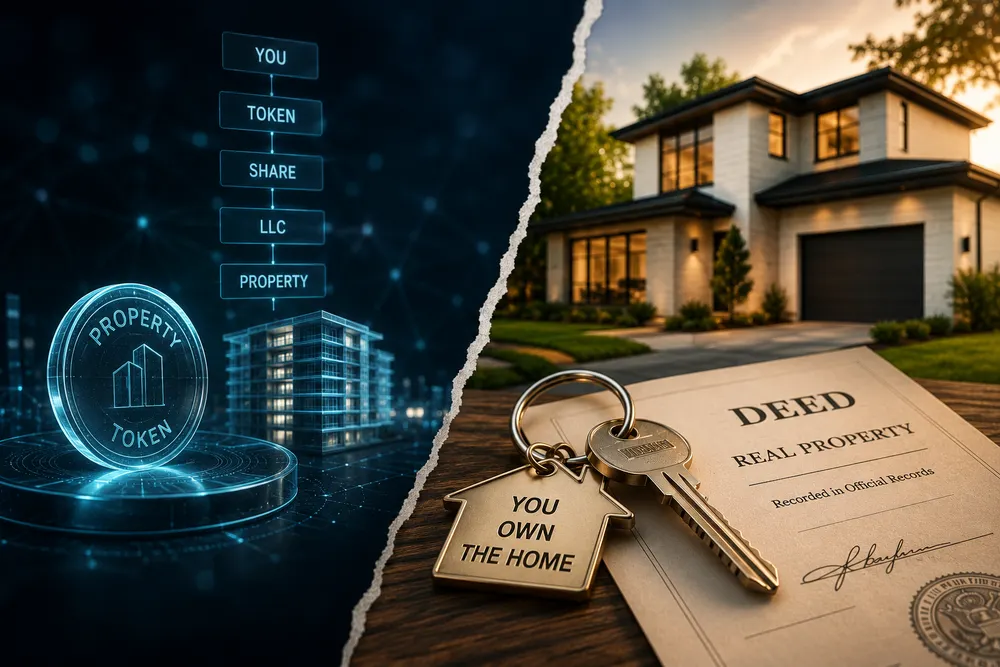
Every cycle, the same deck: real estate is a $300 trillion asset class, tokenization will make it liquid, $3 trillion on-chain by 2030. The slides get prettier. The number doesn't move.
As of this year, tokenized real estate is still well under 0.1% of the global property market. That's not our estimate — that's the concession now appearing in the same publications that ran the projections. A decade in, the revolution's market share needs a microscope.
We should know — we're in the other lane
Full disclosure: RealOpen doesn't sell tokens. We help people buy actual homes with crypto — the coins convert at closing, escrow gets a wire, and the deed records in the buyer's name. So yes, we have a horse in this race. It's just that our horse keeps finishing, week after week, through boring conventional escrow, while the other one is still being 3D-rendered for the next pitch deck.
What a token actually buys you
Here's the part the marketing blurs. In nearly every legitimate tokenization structure, you don't own real estate. You own a token, which represents a share, which represents a claim on an LLC, which owns the property. Three layers of paper between you and the house — and a platform between you and every decision: the rent, the repairs, the property manager, the exit.
That's not a scam. It's a security — a small, passive, managed investment. Perfectly legitimate product. But "own a piece of a Miami duplex from your phone" is doing a lot of work in that sentence, and the honest benchmark isn't home ownership. It's a REIT: deeper liquidity, audited reporting, decades of track record, same passive exposure.
And about that liquidity pitch — "sell your fraction anytime, no realtor, no closing." Look at the order books. Secondary markets for property tokens are thin, some platforms only run periodic buyback windows, and securities rules can lock you up before you're allowed to sell at all. Liquidity comes from buyers, not blockchains. Putting a share on-chain doesn't conjure demand; it just makes the transfer cheap once demand exists.
Even the genuinely interesting news proves the point. Dubai's land department launched regulated secondary trading for tokenized property this year — a real milestone, seriously done. What trades there? Tokens. What doesn't? Homes.
If tokenizing the house isn't the breakthrough — what happens when the buyer's wealth gets tokenized instead?
Nobody tokenizes the house they want to own
If your crypto position is a few hundred dollars, fractions (or better, that REIT) are how you touch real estate. Legitimate use case, no sarcasm.
But if your crypto can buy a property — the one you want to live in, rent out, or hold — a fraction is a detour with extra intermediaries. You don't want 1/5000th of an apartment. You want the deed.
That path exists today, without waiting for anyone's roadmap: verify your wallet, get a proof of funds letter without cashing out, offer on any listing as a cash buyer, convert at closing. Here's exactly how it works.
One more thing the tokenization industry already knows, quietly: some of the investment groups issuing those tokens use RealOpen to acquire the buildings first — funding the purchase with crypto and closing as cash buyers. The acquisition rail is real infrastructure. The fractional wrapper is a product choice. We build the rail.
Want the full, fair breakdown — including where tokenization honestly makes sense? We wrote it straight: Tokenized Real Estate, Explained — and Weighed. And if you're deciding between the two paths: Token vs. Deed.
Last updated

RealOpen lets you buy any house with crypto.
On the market, pocket listed, or just a home you love—RealOpen's platform, handles KYC, proof of funds, and volatility modeling to present an all-cash offer to sellers while you get to hold crypto until closing.