
The RealScore™ Report

A bank statement for a self-custody wallet

A bank account comes with a statement: your name, your address, dollar amounts, and a history. A self-custody wallet gives a lender none of that. So when crypto funds a down payment on a traditional mortgage, the hard part isn't the conversion and it isn't getting dollars to escrow — it's documentation. Four things have to be solved: prove the assets are yours, document them in a form an underwriter can apply their criteria to, convert and deliver the dollars, and show the paper trail from wallet to closing table.

The RealScore™ Report is the first two. It turns a verified wallet's on-chain history into a documented financial asset that can go into a mortgage file — holdings, period balances, seasoning, and a risk-adjusted value — and it does all of it before any crypto moves. The Transaction Record is the fourth: the hash-by-hash trail from that wallet to the wire that lands in escrow.

It isn't a screenshot and it isn't a self-attestation. Wallet ownership is proven cryptographically, holdings are read from the chain, and the valuation is stress-tested per asset — so the number a lender underwrites against is the conservative one.
First, the wallet is proven yours

Two ways, both done from your own wallet, neither of which moves your coins or hands anyone your keys. Sign a message: the report records the exact message and the signature hash. Or send a challenge transfer: you're given a specific small amount — say $2.08 — and sending exactly that from the source wallet proves control. Not every wallet can sign messages and not every buyer wants to, which is why many clients use the transfer.

From that point the address's public history is evidence, and the report reads it the way an underwriter needs to:

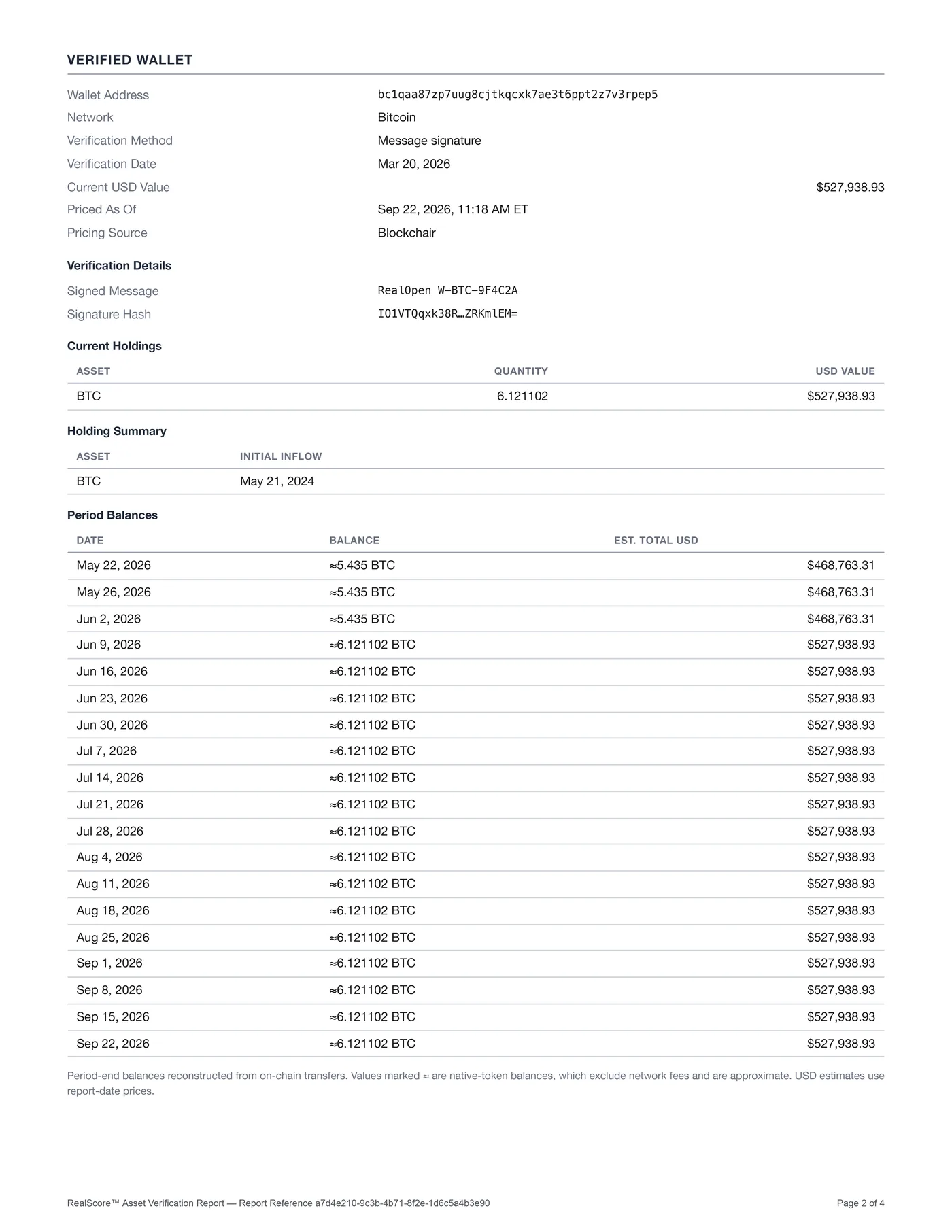
Verified Wallet page of a sample RealScore Report: wallet address, network, verification method and date, current USD value with pricing source, the signed message and signature hash, current holdings, initial inflow date, and weekly period balances across the report window
Page 2 of a sample report — the Verified Wallet. Proof of control, the holdings behind it, when they first arrived, and what the balance was every week of the review window. Click to open full size.

That bottom table is the one lenders care about most. An underwriter is usually looking at a specific window — a minimum amount that was there for a minimum time — and period balances reconstructed from on-chain transfers answer it on one page, with the initial inflow date showing how long the position has existed at all.

What's inside

Every RealScore™ Report documents:

  • Verified identity — the client behind the assets, KYC-verified through Stripe Identity.
  • Verified wallet — address, network, verification method and date, plus the signed message and signature hash or the challenge transfer that proved control. Your keys never move; nothing is custodied.
  • Current holdings and valuation — assets, quantities, USD value, and the pricing source and timestamp it was priced at.
  • Holding history — initial inflow date per asset and weekly period-end balances across the report window, reconstructed from the chain.
  • Seasoned reserve basis — the lowest balance held over the trailing 30 days, so recently deposited funds count toward reserves only once they have seasoned.
  • Qualified buying power — a per-asset qualification rate and the qualified value at 1-, 2- and 3-month horizons, with the risk horizon tied to your closing date (more below).
  • Attestations — plain-language statements of what RealOpen verified, reviewed, and valued, and as of when.
  • Transaction history — every in and out over the report window with amount, balance after, and the transaction hash, so anything on the report can be checked against the chain.

Paired with RealOpen's Transaction Record — the conversion and flow-of-funds paper trail — it forms the exact documentation underwriters want, and lenders have released closing docs on exactly this basis.

Volatility, in a form a lender can use

$500,000 of bitcoin today is not guaranteed to be $500,000 in sixty days, and an underwriter knows it. The report doesn't ask them to take the spot price on faith. The Curve model states, for each asset, how much of today's balance is protected at 99% confidence against adverse movement through each horizon — using the greatest of statistical price risk, options-implied insurance cost, and historical worst-case stress, plus liquidity adjustments where they apply. The risk horizon is set to your closing date, and the model version and market-data timestamps are printed so the figure can be reproduced.

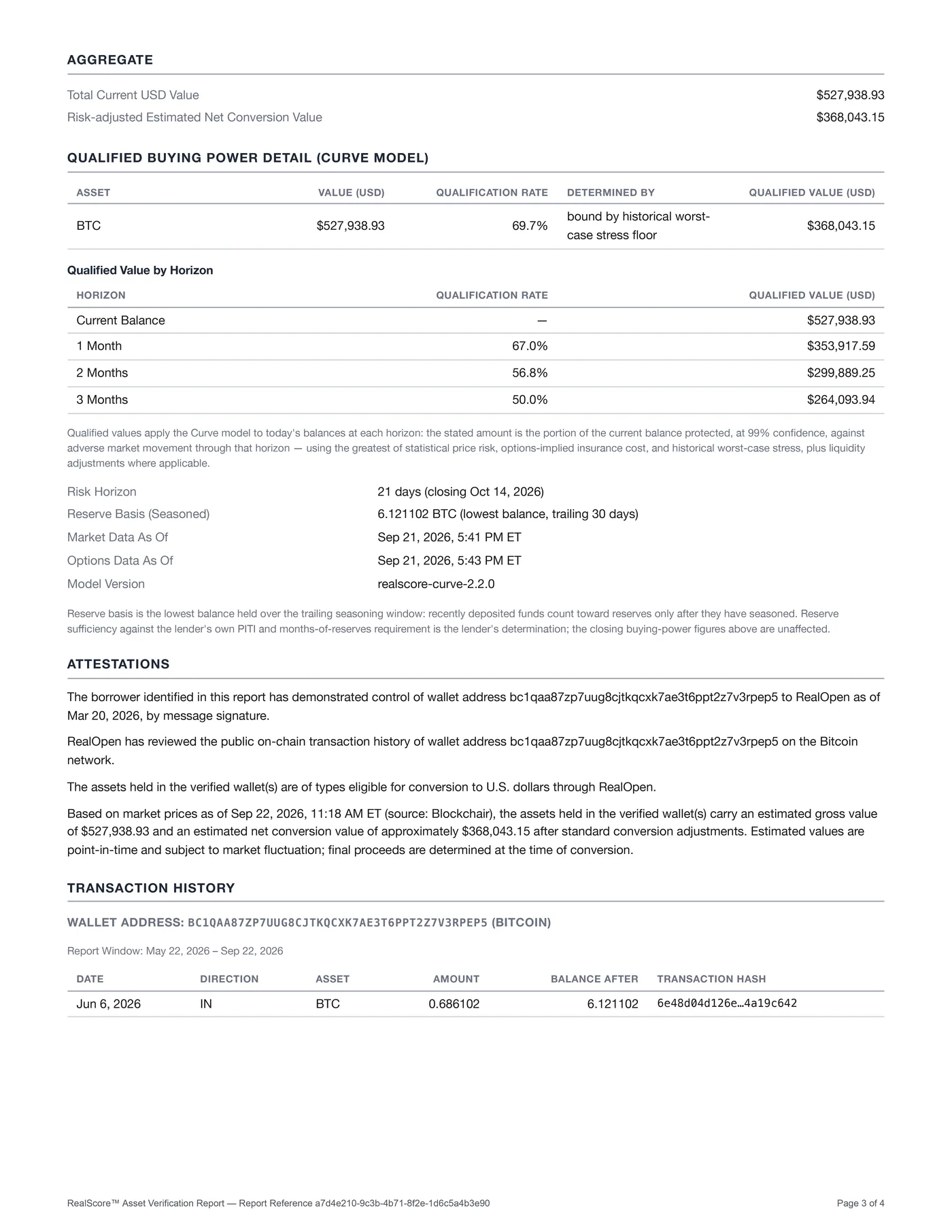
Aggregate and Qualified Buying Power page of a sample RealScore Report: total current USD value, risk-adjusted net conversion value, per-asset qualification rate from the Curve model, qualified value at 1-, 2- and 3-month horizons, risk horizon tied to the closing date, seasoned reserve basis, attestations, and on-chain transaction history with hashes
Page 3 of the same report — Aggregate, Qualified Buying Power and Attestations. In this sample, $527,938.93 of BTC qualifies at $368,043.15 for a closing 21 days out, with the 1-, 2- and 3-month values beneath it. Click to open full size.

Two numbers sit at the top of that page and they are deliberately different: the total current value and the risk-adjusted estimated net conversion value. The second is what the lender can plan on. Reserve sufficiency against the lender's own PITI and months-of-reserves rule stays the lender's call; the report gives them the seasoned basis to make it.

Verifiable by design

Every report carries a document ID and QR code. Check the ID at realopen.com/verify to confirm the document is authentic and current — and drop your PDF copy on that page to confirm it's byte-for-byte what RealOpen issued. Reports stay current for 30 days; a fresh report supersedes the old one, and the verify page says so.

Lenders can go further: a free lender account retrieves the full structured report — holdings, history, valuation — by document ID or API, instead of re-keying from a PDF.

How to get one

Create a RealOpen account, verify your identity, and prove ownership of your wallets — it takes minutes, and your crypto stays exactly where it is. Your RealOpen advisor generates the report from your verified holdings whenever a lender, seller, or escrow officer needs it. You get qualified without selling and without moving anything to an exchange; when it's time to fund, you convert only the amount the down payment needs and the rest stays in your wallet.

One piece of advice that applies to every lender: talk to your loan officer before you move anything. The lender decides what documentation they'll accept, what seasoning they require, where assets have to sit in the months before closing, and when the conversion has to happen. If the first answer is "you can't use crypto" or "liquidate months ahead," ask again — most lenders simply haven't seen this process yet. Send them to realopen.com/lenders or have them reach out to us directly.

Buying with financing? See how the report anchors a crypto down payment without the seasoning detour, or watch the five-minute walkthrough of a self-custody down payment. Paying all-cash in crypto? Start with crypto proof of funds.

Frequently asked questions